 visit Auburn.edu
Business Analytics and Information Systems, Faculty
A storied career: Harbert Eminent Scholar David Paradice retires
 |
|
David Paradice, speaking at an event in 2016, retired in June. He was recruited to Auburn in 2015 as the Harbert Eminent Scholar of Business Analytics. |
Throughout his long, distinguished academic career, Harbert Eminent Scholar David Paradice built a reputation for solving difficult problems by insisting on something deceptively simple: first, make sure the problem you’re solving is the right one.
In June, he retired from Auburn, having made lasting contributions to the education, research and leadership activities of the Harbert College of Business and having positively influenced multiple generations of students and colleagues at Auburn, Texas A&M, Florida State and beyond.
Paradice was recruited to Auburn in 2015 to chair what is now the Department of Business Analytics and Information Systems. At the time, analytics was emerging as a new major at business schools nationwide, and Auburn’s program enrolled just over a dozen students.
“I spent the first couple years educating students, parents, corporate people and faculty in the college about what the analytics program was,” said Paradice, who was well known in industry and academia for his research on structuring problems properly so businesses could use technology and data to arrive at the best solutions.
Paradice also hired a team of exceptional faculty, forged strong industry partnerships and led the revamping of the information systems curriculum to better align with industry needs. He convinced several companies to share real-world data with faculty to enhance the students’ educational experience. The result? More companies came to recruit Harbert students.
In 2020, Paradice returned to the faculty to focus on his teaching and research.
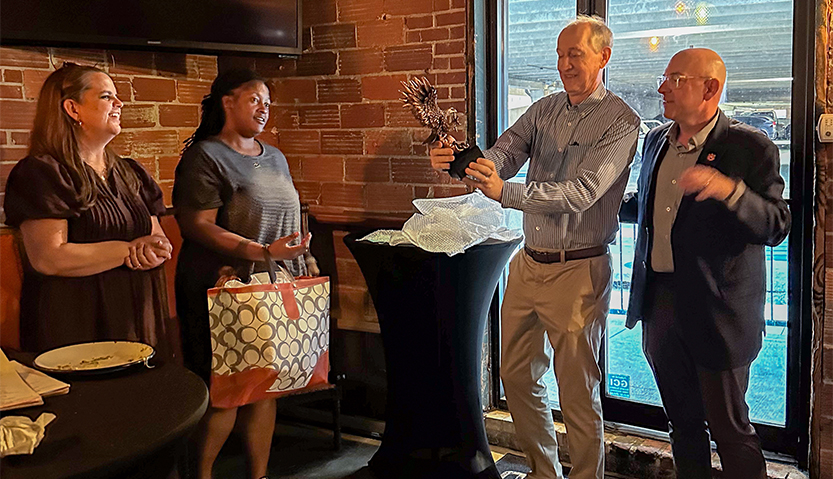
Colleagues from the Department of Supply Chain Management present Paradice with a gift at a retirement reception in September 2026.
Benoski Professor Uzma Raja, who succeeded Paradice as department chair, and other faculty have built on those initial industry partnerships, which now provide the department’s more than 300 students with enhanced learning opportunities such as internships, capstone projects and business analytics case competitions.
Their collective efforts are paying off as the Auburn business analytics undergraduate program is ranked No. 13 among public schools and No. 34 among all schools according to U.S. News & World Report.
“David was foundational in setting up the curricula, he made some great faculty hires who have been very successful, and he mentored Ph.D. students who have gone on to make a difference [in their fields],” said Raja. “But his contributions have been bigger than that. He’s a visionary leader whom people look up to and seek his guidance and counsel.”
According to Raja, another aspect of Paradice’s Auburn career has been his willingness to fill executive leadership positions within Harbert when needed.
“He has stepped in every time he was called,” said Raja, noting that Paradice also held leadership roles elsewhere earlier in his career. “As a leader his impact has been to help others do great things.”
 |
|
A longtime patron of the Gogue Performing Arts Center at Auburn, Paradice (right) occasionally gives tours to groups of visitors. |
A trusted mentor and colleague
Harbert Dean Jennifer Mueller-Phillips asked Paradice to temporarily step into her former role as associate dean of academic affairs since he’d previously held a similar position at Florida State’s Wertheim College of Business.
He embraced the role and helped the college accelerate the pace of its change management efforts.
“David looks at the world a little differently, likely because of his engineering background, and I always appreciated that about him,” said Mueller-Phillips, referring to his expertise with systems and technology. “When we decided to go in a different direction with the college’s Salesforce implementation, David provided a lot of guidance on creating a better system than what we had, with the ultimate goal of improving our data-driven decisions and strategic direction.”
Perhaps more importantly for Mueller-Phillips, he was a reassuring presence willing to provide advice on issues whenever asked. “And by that, I do not mean that he always agreed with me. Rather, he would help me see an issue from a different angle and would often share a perspective that I had not fully considered.”
“He provided a lot of mentorship and wisdom to me personally,” she said. “He had such a passion for helping me as a new dean.”
Mueller-Phillips tapped Paradice for one final leadership position in 2025 as interim chair of the Supply Chain Management Department while the college conducted a national search for a new chair.
“David knew the faculty and their work, and he was someone they had confidence in to keep the department moving forward,” said Mueller-Phillips. “He’s had such a passion for wanting the Harbert College of Business to keep advancing that he was willing to put his own retirement on hold to really help us. That’s such a testament to both David and the college’s culture, which is so special to me.”
 |
|
Paradice has positively influenced the lives and careers of countless students. In 2023, Business Analytics senior Kyle Davis (right) received the first Paradice Analytics Scholar award, which a generous donor established as a tribute to Paradice. |
The Paradice effect
In all, Paradice either chaired or was a member of 64 doctoral dissertation committees during his career with nine of the Ph.D. graduates earning their degree at Auburn.
He helped then-doctoral candidate Stephen Dawe refine the focus of his research interest in smart cities, a topic that was particularly pertinent to Dawe as CIO of Opelika, Ala.
Without Paradice’s expertise in helping students fully understand a problem before they tried to solve it, Dawe said he’d likely not have gotten his research off the ground.
“He helped me define what a smart city is and what in that definition I really wanted to research,” said Dawe, who earned his doctorate in 2021 and continues in his role as Opelika CIO.
“From a research perspective, Dr. Paradice was a brilliant mentor because he taught me how to think about a problem, and he taught me how to be critical and intentional about what I’m looking at, which has made me significantly more productive,” said Dawe.
Whether he’s preparing for a meeting with the mayor, writing an article for a trade magazine or creating a seminar presentation, Dawe continues to apply the Paradice principles to his work.
“Whatever it is I’m doing, it really comes down to what would Dr. Paradice say, or how would he approach this,” said Dawe. “It was a pleasure to work with him, and I am a better man because of him.”
Ross Gruetzemacher earned his doctorate in business analytics under the supervision of Paradice in 2020, completing his dissertation on forecasting transformative AI.
“I couldn’t have asked for a better advisor,” said Gruetzemacher, noting that Paradice’s financial support and vast network of connections enabled him to attend 25 AI conferences and interview 45 of the world’s leading AI experts as part of his dissertation research.
“Dr. Paradice was supporting my research on advanced AI and AGI [artificial general intelligence] 10 years ago, well before others,” Gruetzemacher said.
“His support had an indelible positive impact on my career. Without it and without the resources at Auburn, I would not have been able to pursue my [research] passions, which have led me to many great things, including [being] a research affiliate at the University of Cambridge’s Centre for the Study of Existential Risk.”
In addition, Gruetzemacher is an associate professor at Wichita State University and the founder and executive director of the Transformative Futures Institute, a non-profit that mitigates societal-scale risks from advanced AI.
“While David and I haven’t published as much since I graduated, he continued to be involved with my work and [served] as a founding board member of [the Institute],” he added.

David and Cheri Paradice
The genesis of problem formulation
Being able to frame complex problems in ways that facilitate better solutions is a skill that Paradice learned as a doctoral student at Texas Tech working with faculty advisor Jim Courtney, a highly regarded pioneer in decision support systems. According to Paradice, Courtney encouraged his management information systems Ph.D. students to approach model design from various perspectives.
“For my dissertation, I took more of a statistical approach. Had I been more prescient, I would have called it analytics or business intelligence, but I didn’t,” said Paradice, whose thesis was titled “Causal Modeling as the Basis for an Intelligent Business Problem Formulation System.”
Paradice noted that this approach to problem framing was broad enough that it could be applied to many fields. In practically any field, he suggested, if you get the problem right, the solution will tend to reveal itself.
“It didn’t pigeonhole you into finance, real estate or marketing [but it could be applied] to medicine, construction, really anything,” he said. “It opened the door to a lot of interesting things that you can explore, which is what I kind of tried to do with my career.”
Throughout his 40-year academic career, Paradice said the goal of his research and teaching was to “give people feedback on whether it seemed like they had the structure of a problem right and were considering the right things.”
He pointed out that when businesses fail or they have catastrophic product rollouts, more than likely the company changed something that didn’t need to be changed because they were trying to solve the wrong problem.
“There are so many factors that have to be considered with a lot of business problems,” said Paradice, referencing variables like market, political, ethical, employee and economic forces. “Finding solutions can be very difficult, particularly if the problem a firm is solving hasn’t taken all these factors into consideration.
“My work examines whether you are solving the right problems, how to use technology to mitigate biases, recognizing the complexity of problems better and [knowing when] some problems are not solvable and should just be managed,” he added.
 |
|
David Paradice and his wife Cheri fully restored this 1971 MGB roadster over the years. |
The joys of retirement
Since he retired in June, Paradice is relishing his free time. He earned his drone pilot’s license, is learning to play the ukelele and plans to take up golf again — a sport he hasn’t played regularly since he became associate dean of academic affairs at Florida State 16 years ago.
He continues to be involved with the Gogue Center for the Performing Arts at Auburn, where he’s a member of the center’s engagement committee and “unofficial tour guide.” An avid soccer fan and former midfielder for a club team in college, Paradice generously supports the Auburn Women’s soccer team.
Paradice also occasionally works on his 1971 MGB sports car, which he and his wife Cheri have fully restored since purchasing it more than 20 years ago. “It’s not a car, it’s a career,” he said wryly.
###