visit Auburn.edu
A.I., Center for Supply Chain Innovation
AI, tariffs top agenda for Center for Supply Chain Innovation's 2026 Fusion
 |
Supply chain management was a whirlwind after COVID-19 in a recovering, high-demand, move-fast global market. But then during 2025, in addition to embracing the rapid development of artificial intelligence (AI) and the introduction of other digital tools came a major new challenge: tariffs.
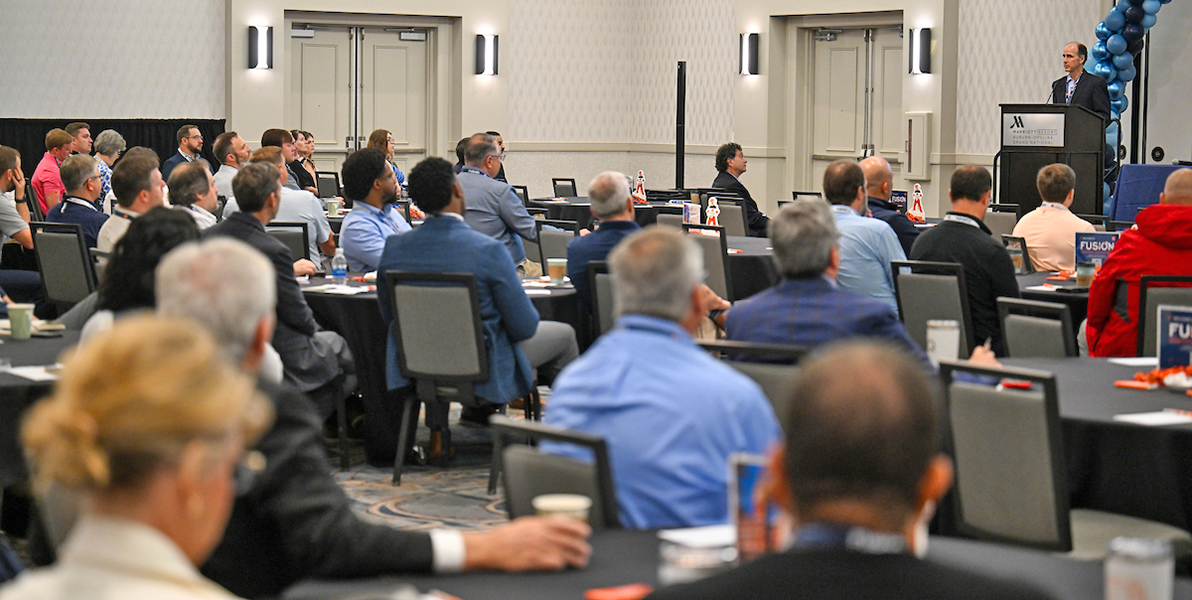
Now in 2026, AI and tariffs dominate discussion and strategic management decisions, said two keynote speakers at the Auburn University Harbert College of Business FUSION 2026 event, which brings together professionals, academia and others connected to supply chain management.
Fusion is hosted by Harbert’s Center for Supply Chain Innovation.
Anyone in business knows that the constantly changing tariff policies of the United States, European Union and other global trading markets has produced an impact that continues to evolve, said speaker Chris Rubio.
“I’ve been in the industry for three decades, and I’ve never seen anything quite like what happened last year,” he said.
 |
|
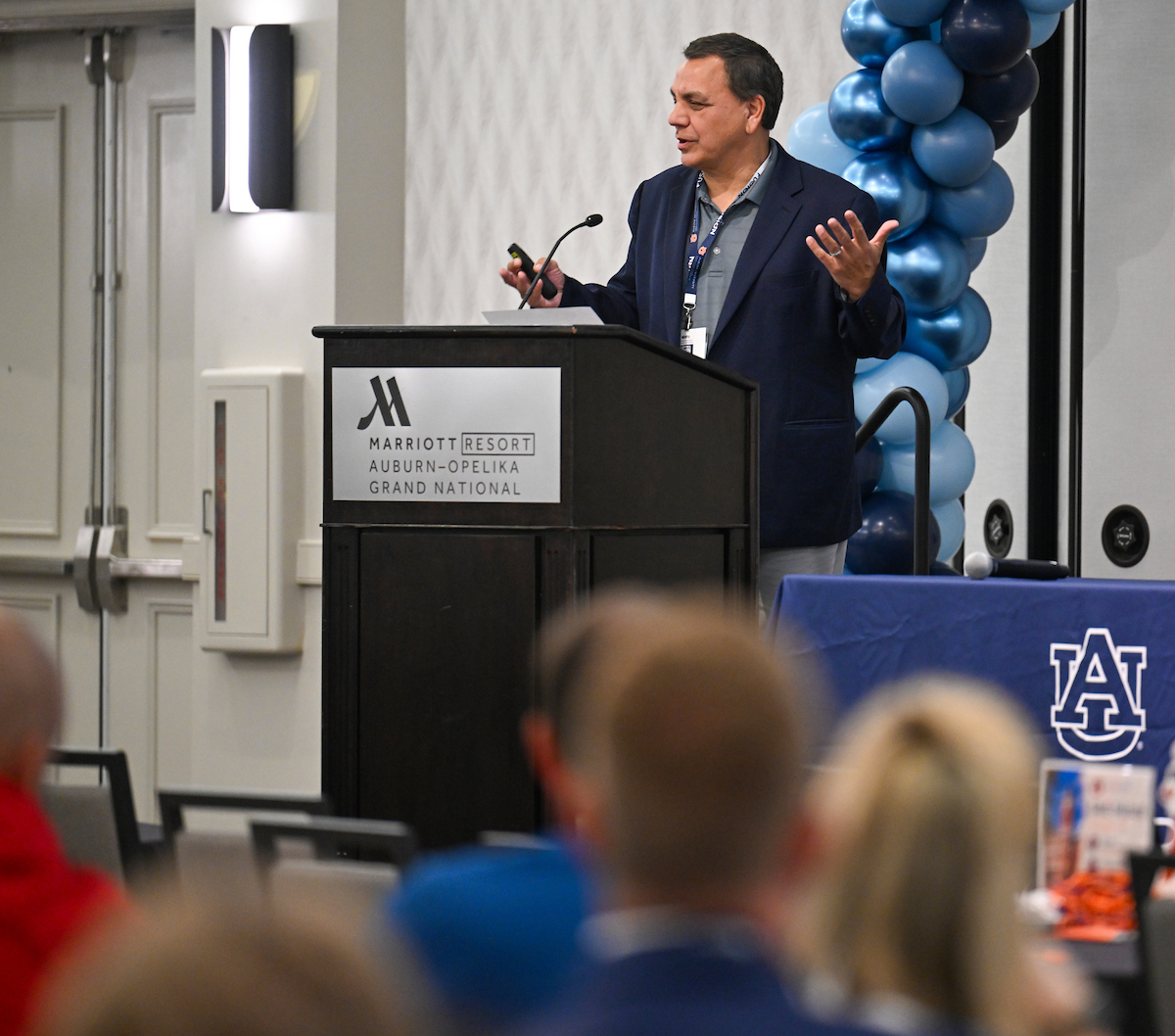
Chris Rubio, who leads global customs brokerage strategy at UPS, presented a keynote address at FUSION 2026. |
Rubio leads global customs brokerage strategy at UPS, overseeing business development and technology platforms across more than 220 countries.
“The global supply chain was quite disrupted in 2025,” he said. “Everything was being disrupted, in real time, and every time things changed, we had to stop and reassess how it was affecting our company.”
Across the economy, supply chain disruptions occurred, and businesses reacted.
“We made changes, and then boom, we reversed it,” Rubio said. “There were changes, almost every week last year... How do you explain this to customers? How does it affect pricing of products?
“So, a lot of change, and a lot of delay in the global supply chain last year.”
An end to the sudden changes in trade policies isn’t likely to become settled anytime soon as other global events occur, Rubio predicted.
“Regarding the geo-political environment... we feel that the world has changed permanently,” he said. “It won’t go back to the way we traded before 2025.
“What we can prepare for is a future where there will be geo-political diversity,” Rubio said, and this will require firms and businesses to continue finding ways to manage the changes. “It will be a very interesting new environment that we find ourselves in, with respect to geo-politics.”
AI as a worthy investment
Peter Swartz is the co-founder and chief science officer at Altana, which develops AI-driven solutions for global trade.
“It’s a moment of change in global trade,” he too told the FUSION audience.
Swartz praised the effectiveness of creating AI-based systems that can track a wide array of data needed by supply chain managers, including faster inventory control, evaluating scale, expediting transactions and simply doing more, faster in the overall supply chain process.
“What we are talking about is superhuman speed of knowledge... systems that read every language, can compute,” he said, “and allow humans to focus on the higher-value tasks.”
He also foresees the development of novel capabilities yet to be implemented.
“Generative AI is enormously impressive and is a huge investment,” he said.
However, he warned against losing the necessary guardrails to keep systems accurate and reliable. “Just like you would test a human system for reliability, you would need to test an AI system.”
Human editing remains a required element in using AI, but the value will be evident, such as when “systems will say, ‘hey, this is the best action,’” Swartz said.
A new field of engineering
Regarding the ongoing rollercoaster ride in trade, another evolution still taking place -- and likely to continue -- is what Rubio referred to as “tariff engineering.”
It involves working with customs officials in advance to get the proper approval of what is acceptable and what isn’t, he said, but more and more companies are analyzing the tariffs for where they can find benefits in creative strategy.
He cited a case study involving Ford Motor Company and its production of conversion vans.
Tariffs at one point on passenger vans were at 2.5 percent, while work vans and pickup trucks faced a tariff rate of 25 percent.
“Ford imported the vans as passenger vans, cleared customs, then hired a team to rip out the back seats, rear seatbelts, and other items to create work vans,” Rubio explained. “It saved Ford $250 million.”
 |
|
Following the FUSION conference, participants enjoyed networking with one another at the annual golf outing. |
FUSION 2026 takes root
FUSION 2026 is the ninth annual supply chain symposium hosted by Auburn’s Center for Supply Chain Innovation, having taken place May 7-8 in Opelika at the Marriott Resort & Spa at Grand National.
Other topics during the event included how to address the problem of cargo theft, and emerging trends with supply chain talent.
Joe Hanna, Regions Bank Professor of Supply Chain Management at the Harbert College of Business and executive director of the center; and Irv Grossman, the center’s director, served as hosts for the event.
“The Center for Supply Chain Innovation was launched in 2016 with the idea of enhancing interactions between practitioners and educators for the benefit of supply chain industry participants,” Hanna said. “Over the last decade, the FUSION educational symposium has grown from an idea to an annual event that includes Center sponsors, numerous friends of Auburn University’s supply chain programs and other participants of the supply chain practitioner community.”
A key reason for the success of the program is that it allows content experts from academia and practice to come together to share ideas and expertise on how to address current issues and challenges, he said.
“As opposed to many of today’s supply chain industry-oriented conferences that are characterized by trade shows and sales booths, the focus of our FUSION symposium is on education,” Hanna said. “This symposium structure allows academicians to share the results of their research, and practitioners to collaborate and present approaches they have used to address some of the major challenges associated with managing various supply chain issues.”
Grossman agreed and added, “The topics addressed in this year’s conference are not only topical, but they represent the constant change and speed of evolution.
“Presenters have had the challenge to be current with their insights while keeping a close eye on current technology, geopolitical and financial environment,” he said.
Sponsors of the Center for Supply Chain Innovation include:
- Regions Bank
- Webb Wheel Products
- AAA Cooper Transportation
- Buffalo Rock
- GE Appliances
- ABC Supply Co. Inc.
- ASF
- Buddy Moore Trucking
- DHL Supply Chain
- Motion
- Georgia Pacific
- PS Logistics
- McLeod Software
- Penske Rental/Leasing/Logistics
- Delta TechOps
###
Learn more about Auburn's Center for Supply Chain Innovation
Learn more about the Department of Supply Chain Management in Harbert College